

Perth’s hot, dry summers can make temporary cooling necessary for workplaces, warehouses, events and other spaces. Options available for hire include portable air conditioners, evaporative coolers, cooling fans, misting fans and packaged air conditioning units. The right choice depends on the space, ventilation, heat load, airflow requirements and whether cooling is needed indoors or outdoors.
Summer cooling is rarely a one-size-fits-all problem. An enclosed office, open warehouse and outdoor event can experience the same hot weather but need completely different approaches to stay comfortable. The type of space, how many people use it, the available ventilation and even the equipment operating inside it can all affect the cooling requirement.
Perth’s climate makes temporary cooling particularly relevant during the warmer months. Hot, dry conditions can create very different cooling requirements depending on whether the equipment is being used in an enclosed room, ventilated warehouse, outdoor event area or industrial workplace.
For a short-term project, seasonal workplace, event or commercial facility, hiring cooling equipment can be more practical than installing a permanent system. The important part is matching the equipment to the environment rather than simply choosing the largest unit available.
7 Cooling Equipment Options to Hire in Perth
1. Portable Air Conditioners
Portable air conditioners are a practical option when you need refrigerated cooling in an enclosed or defined area. They can suit temporary offices, retail spaces, construction offices, server rooms, event areas and other indoor environments where simply moving air is not enough.
AirXpress Hire’s portable air conditioner hire range includes several capacities, including 5kW, 6kW and 10kW models. Portable AC units can also be used for spot cooling when only a particular workstation, machine, server area or temporary room needs additional cooling.
Before hiring, check the available space, exhaust arrangement and electrical requirements. These factors can affect where the unit can be positioned and how effectively it can operate.
2. Evaporative Coolers
Evaporative coolers use water evaporation to produce a cooling effect while moving substantial volumes of air. They can be useful in warehouses, workshops, construction areas, logistics facilities and other spaces where there is enough ventilation for air to circulate.
Perth’s generally dry summer conditions can make evaporative cooling suitable for some applications. AirXpress Hire’s evaporative cooler range includes units from 250 L/s through to much larger industrial models.
Unlike refrigerated air conditioning, evaporative cooling works best where fresh air can move through the space. A sealed room and a well-ventilated warehouse therefore require different considerations when selecting equipment.
3. High-Volume Cooling Fans
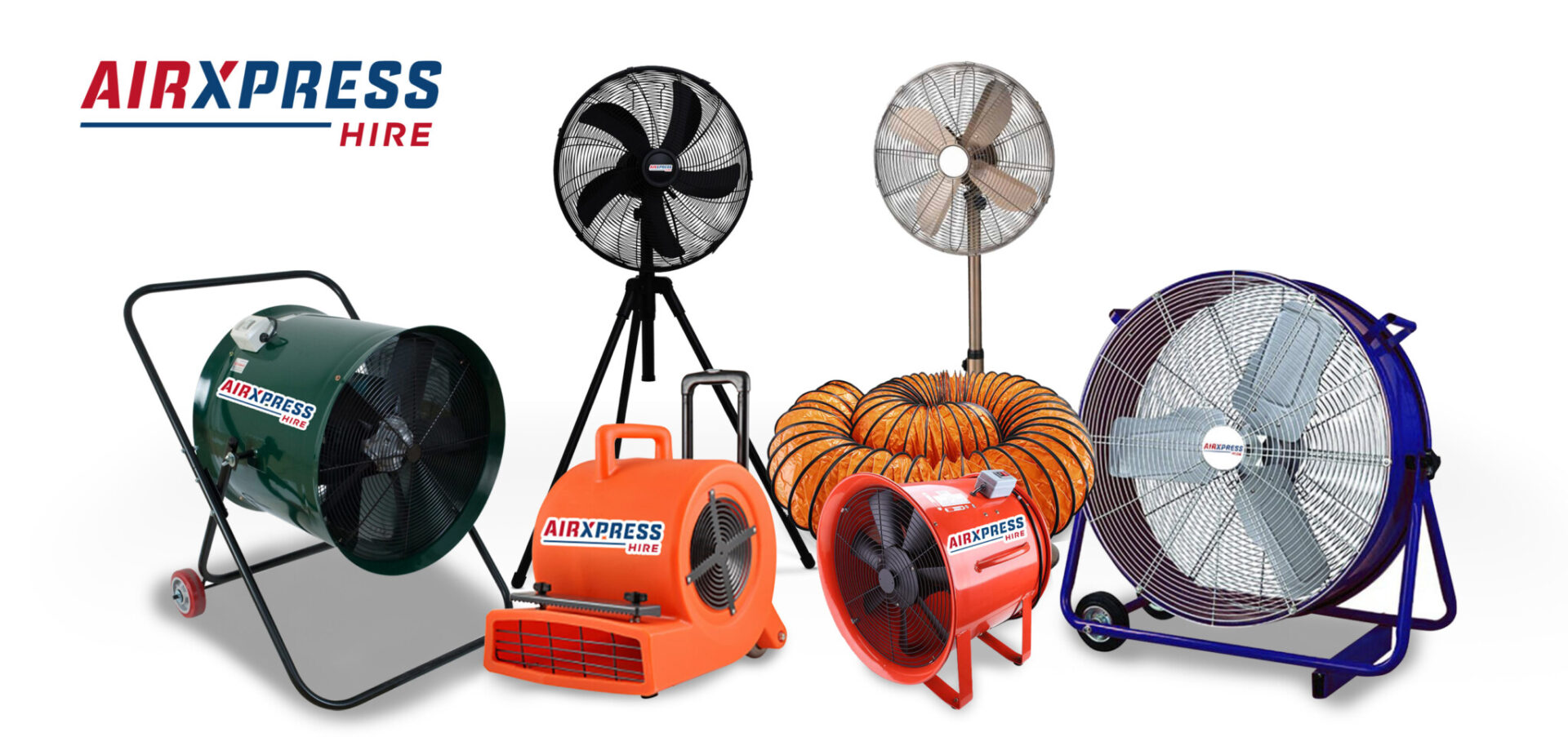
Cooling fans can be useful when the main issue is stagnant air or insufficient air movement. They do not actively reduce the air temperature like refrigerated air conditioning, but strong airflow can improve comfort by moving air across occupied areas.
They can suit warehouses, workshops, marquees, construction areas, retail spaces and other temporary environments. AirXpress Hire’s cooling fan hire range includes pedestal fans, industrial pedestal fans and drum fans in different sizes.
For larger areas, placement matters as much as fan size. Consider where people are working, where heat is being generated and whether machinery or other obstructions could interrupt the airflow.
4. Misting Fans
Misting fans combine fan-driven airflow with a fine water mist, making them particularly useful for outdoor and semi-open environments where conventional air conditioning may not be practical.
They can be used around outdoor events, hospitality areas, sporting activities, courtyards and temporary work zones. As the fine water droplets evaporate, they can provide a cooling effect around the area where the fan is operating.
AirXpress Hire currently offers a 500mm misting fan with adjustable tilt and three fan speeds. Access to water and suitable placement should be considered before use. The position should also take into account electrical equipment and other items that may be sensitive to moisture.
5. Drum Fans for Large Work Areas
Drum fans are a high-airflow fan format designed to move substantial volumes of air across larger work areas. They can be useful in warehouses, workshops, construction sites, marquees and other spaces where stronger air circulation is required over a wider area.
AirXpress Hire’s cooling fan range includes drum fans in different sizes and airflow capacities. Their larger format can make them useful where a smaller pedestal fan may not provide enough air movement.
However, bigger does not automatically mean better. The fan should be positioned so that airflow can reach the occupied area without being blocked by walls, machinery, stored materials or other site obstructions.
6. Industrial Chillers
Industrial chillers provide a larger-scale cooling solution for commercial and industrial applications where portable air conditioners or air-movement equipment may not be sufficient.
Unlike fans, which primarily move air, or evaporative coolers, which rely on water evaporation, chillers provide cooling through a dedicated cooling system. Their suitability depends on the application, required capacity and how the cooled system or area is configured.
Chillers also require more planning than portable equipment. Power requirements, connections, access, installation arrangements and the overall cooling setup should be assessed before hire. They are generally better suited to projects with substantial or specialised cooling requirements rather than simple spot cooling.
7. Large-Area Packaged Air Conditioning Units
Packaged air conditioning units are designed for larger commercial and industrial cooling requirements where several portable units may not provide a practical solution.
AirXpress Hire’s packaged air conditioner range includes units starting at 56kW, with larger capacities available. The listed 56kW model provides 2,800 L/s of airflow and requires a three-phase electrical supply with a hard-wired connection.
These systems require more planning than portable AC, including consideration of electrical supply, equipment placement, access and air distribution. They can be considered for larger temporary cooling projects where substantial cooling capacity is required.
Which Cooling Option Makes Sense for Your Space?
The right option depends on the environment rather than simply the size of the equipment. A small enclosed office may need refrigerated cooling, while a large ventilated warehouse could benefit more from high-volume airflow.
| Cooling equipment | Most suitable for | Environment | Main advantage |
| Portable AC | Offices, rooms and enclosed areas | Indoor | Direct refrigerated cooling |
| Evaporative cooler | Warehouses and workshops | Ventilated indoor/semi-open | High-volume cooled airflow |
| Cooling fan | Work areas and large spaces | Indoor/outdoor | Strong air movement |
| Misting fan | Events and outdoor areas | Outdoor/semi-open | Airflow with fine mist |
| Drum fan | Large work areas and warehouses | Indoor/outdoor | High-volume air movement |
| Industrial chiller | Larger commercial and industrial applications | Project-dependent | Higher-capacity cooling |
| Packaged AC unit | Large commercial/industrial areas | Project-dependent | High-capacity refrigerated cooling |
This table should be treated as a starting point rather than a sizing calculation. Ceiling height, insulation, solar exposure, machinery, occupancy and ventilation can all change the actual cooling requirement.
Match the Equipment to the Perth Summer Environment
For an enclosed office or temporary room, a portable air conditioner is generally the more suitable starting point when the goal is to actively lower the temperature.
For an open warehouse or workshop, evaporative cooling or high-volume fans may be more practical. These spaces often have doors or openings that allow air to move through the area.
For an outdoor event, misting fans can provide localized cooling around seating, entrances, hospitality areas and other high-use locations.
For a large work area, drum fans can improve air movement across occupied zones without attempting to condition the entire building.
For a specific workstation or heat source, portable AC can be used for spot cooling where targeted refrigerated cooling is required.
For a large commercial or industrial requirement, packaged air conditioning or industrial chillers may be considered when the cooling demand goes beyond what smaller portable equipment can reasonably provide.
What to Check Before Hiring Cooling Equipment
Area and ceiling height: Floor area alone does not determine cooling requirements. A high-ceiling warehouse and a low-ceiling office with the same floor area can behave very differently.
Indoor or outdoor location: Identify where the equipment will operate before selecting it. Portable AC, evaporative coolers, fans and misting fans have different operating requirements.
Ventilation: This is particularly important when considering evaporative cooling. The space needs suitable air movement for the system to work effectively.
Heat sources: Machinery, computers, lighting, direct sunlight and high occupancy can all increase the cooling demand.
Number of people: An occupied event space can require a different approach from an empty storage area, especially during the hottest part of the day.
Available power: Check the electrical supply before hiring. Larger packaged units can require three-phase power and hard-wired connections, while some smaller portable units can operate from standard power points.
Operating duration: A one-day event, several-week construction project and seasonal workplace may each require different equipment and hire arrangements.
Placement and access: Check that the equipment can be moved into position and that there is enough space for airflow. Larger units may also require planning around doors, loading areas, lifts and electrical connections.
Common Summer Cooling Mistakes to Avoid
One of the most common mistakes is selecting equipment based only on floor area. The number of people in the space, heat-producing machinery, sunlight and ventilation can all affect how much cooling is actually needed.
Another issue is using evaporative cooling in a space without considering ventilation. These systems are generally better suited to areas where air can circulate rather than tightly sealed rooms.
Blocked airflow is another easy problem to overlook. A fan or cooler placed behind equipment, against an obstruction or in a poorly positioned corner may not distribute air effectively across the occupied area.
It is also worth checking the power requirements before the equipment arrives. A unit that needs a particular electrical supply can create unnecessary delays if the site has not been prepared.
Finally, avoid leaving the decision until the hottest day of the summer. Checking access, power, ventilation and the intended cooling area in advance gives you a much better chance of selecting equipment that suits the application.
FAQs
What is the best cooling equipment to hire in Perth?
There is no single option that works best for every environment. Portable air conditioners suit enclosed areas, while evaporative coolers and fans can be useful in ventilated spaces, and misting fans are better suited to many outdoor applications.
Are evaporative coolers suitable for Perth summers?
They can be suitable for Perth’s hot, dry conditions, particularly where there is adequate ventilation. The suitability of an evaporative cooler still depends on the space, airflow and cooling requirements.
What cooling equipment is suitable for an outdoor event?
Misting fans and cooling fans are practical options for many outdoor or semi-open events because they do not require the area to be fully enclosed. Equipment placement should be based on the event layout, crowd distribution and available services.
Can portable air conditioners cool a warehouse?
They can be useful for spot cooling specific areas rather than necessarily cooling the entire warehouse. AirXpress Hire lists portable air conditioners for warehouse spot-cooling applications.
What should I consider before hiring a cooling unit?
Consider the area, ceiling height, ventilation, heat sources, occupancy, power supply, hire period and equipment placement. These factors help determine whether refrigerated cooling, evaporative cooling or air movement is the more appropriate solution.
Can cooling equipment be hired for short-term projects?
Yes. Temporary cooling equipment can be used for events, construction projects, temporary workplaces, commercial operations and seasonal requirements. AirXpress Hire offers several cooling equipment categories for different temporary applications.
Final Thoughts
Choosing cooling equipment for a Perth summer comes down to matching the equipment to the environment. Portable air conditioners can suit enclosed rooms, while evaporative coolers and industrial fans may work better in ventilated warehouses and workshops. Outdoor areas may benefit from misting fans, while larger commercial requirements can call for packaged air conditioning.
Before hiring, consider the space, airflow, heat sources, power supply and how long the equipment will be needed. A little planning beforehand can make the difference between equipment that simply operates and a cooling setup that actually suits the job.
If you’re unsure which type of cooling equipment fits your space, call AirXpress Hire on 0451 663 033 to discuss your requirements and get practical suggestions based on the application, location and hire period.